
Logistics includes storage, transportation, packaging and handling of a product from the point of its manufacturing to the point when it finally reaches the end-user. It plays the same role in e-commerce but with an additional step of responsibility – that is the payment collection. The entire journey of your product is tracked online using different software solutions. Thus, we can consider e-commerce logistics as a technology-driven online version of the conventional logistics process.

What is e-commerce logistics?
In simpler words, if you are an online seller, e-logistics involves the handling and transportation of your product from the manufacturer to the supplier, then to you, and finally from your hands to your customers. Often it goes a little beyond this, when your customer decides to return or cancel the order. In such cases getting the product back to you also becomes the duty of your logistics provider. An article by The Economic Times suggests that 90% of customers in tier 3 and tier 4 cities have adopted COD (cash on delivery). Providing you this sum also comes under the ambit of e-logistics.
Importance of e-commerce logistics for online startups
If you have recently started your business, you may be aware that sourcing products from suppliers and then successfully delivering them to your customers within a stipulated period can be a tricky affair. The simple reason being – the product passes through several interlinked stages. Errors made in any one of the stages can significantly delay the delivery of the product. If mismanaged or neglected, the product can easily get lost or severely damaged. As an online seller, since you are the direct point of contact for your customer, they may hold you responsible for any delivery error even if you are not the one who is making it.
A positive delivery experience brings customer loyalty and encourages them to make repeat purchases. Research reveals that 84% of customers do not prefer buying goods from a seller after a poor delivery experience. Therefore, the worst-case scenario for you can be losing valuable customers due to poor delivery or losing money by refunding customers for delivering damaged products. Either of these situations can land you in some serious trouble and lead to losses. Moreover, since online startups generally struggle with their funding, losing out money due to inefficient e-commerce logistics services is the last thing you as an online startup owner would want.
A positive delivery experience brings customer loyalty and encourages them to make repeat purchases. Research reveals that 84% of customers do not prefer buying goods from a seller after a poor delivery experience. Therefore, the worst-case scenario for you can be losing valuable customers due to poor delivery or losing money by refunding customers for delivering damaged products. Either of these situations can land you in some serious trouble and lead to losses. Moreover, since online startups generally struggle with their funding, losing out money due to inefficient e-commerce logistics services is the last thing you as an online startup owner would want.
In-house logistics versus having third-party logistics partner
As mentioned earlier, having efficient e-commerce transport and logistics are necessary for your online startup. You can either arrange an in-house logistics team or consider taking help from any third party. Both of these solutions work well to solve startups’ e-commerce logistics challenges in their own ways. In-house logistics can be better controlled, easily customized and offer greater reliability. Third-party logistics partners on the other hand, though comparatively expensive, may often have proven expertise and a well-established network, which can greatly improve your product delivery process.
However, collaborating with an unreliable e-commerce logistics company can lead to lack of transparency, delay in deliveries, lost products, and other issues that can negatively affect the overall customer experience. Similarly, in-house logistics cannot provide efficient services if your target customer base is wide. Before making a choice, you should carefully compare both these models and then pick the one that suits your needs.
However, collaborating with an unreliable e-commerce logistics company can lead to lack of transparency, delay in deliveries, lost products, and other issues that can negatively affect the overall customer experience. Similarly, in-house logistics cannot provide efficient services if your target customer base is wide. Before making a choice, you should carefully compare both these models and then pick the one that suits your needs.
Operations involved in e-commerce logistics
The e-commerce logistics cycle can be broken down into the following six major components:
- First mile logistics – Involves picking up goods from manufacturers or suppliers and then delivering them to your warehouses or places where you wish to store them.
- Fulfillment – Involves packaging of products and then bringing them to the ‘pickup point’ (place from where the delivery agent will collect it).
- Processing/sorting – Involves dividing products into groups and sub-groups based on their delivery location, time available for delivery, nature of products, or other similar factors. For example, products that are to be delivered to Kolkata will come under one category. Out of these, the fragile items from one sub-group, perishable goods like eatables or goods like medicines that require speedy deliveries form a different group. This grouping is flexible and can be customized.
- Line-haul – Involves deciding the mode of transportation to be used based on the group the product belongs to and then connecting it to the most appropriate supply chains. For example, perishable goods or urgent deliveries should be transported using airways and need to be connected to the related supply chain. Local deliveries can be done using road transport, so on and so forth.
- Last-mile logistics – Involves transportation of products to the final delivery location, i.e. to your customer and collecting payments in case of POD (pay on delivery).
- Returns - 30% of products purchased online are returned by customers. Returned products may include incorrectly delivered products, damaged products, product packages with wrong delivery addresses, not finding the customer at the specified delivery location, refusal from customers to accept the order, etc.
Challenges faced by SMBs in e-commerce logistics
As previously explained, logistics is a sum total of different interlinked stages. Efficiently managing every stage is important as well as time-consuming and difficult. The entire journey can be filled with the following challenges:
Improving customer experience:
Delayed deliveries, high shipping charges, receiving damaged or wrong products, inability to track orders, unavailability of a person to solve problems or answer queries related to deliveries are some of the common issues that lead to product returns, which becomes a major challenge for 57% of sellers.
Ensuring faster deliveries:
63% of customers want their products to be delivered within 3 days from placing an order. Having an online store can require you to deliver products to different states and even outskirts. Therefore, always managing speedy deliveries despite traffic and other disruptions can serve as a challenge.
Boosting efficiency:
If the transportation data is managed manually and there are no software-based solutions to ensure real-time tracking of your products, your logistics may naturally become more prone to errors. Reducing these human errors can easily turn out to be a challenge for you when you manage large-scale deliveries.
These challenges are just a few among the several roadblocks that your e-commerce logistics might face. Adopting a logistics management software can easily help you overcome most of these challenges. Click here to know more about the logistics management software solutions.
These challenges are just a few among the several roadblocks that your e-commerce logistics might face. Adopting a logistics management software can easily help you overcome most of these challenges. Click here to know more about the logistics management software solutions.
How to find the right e-commerce logistics partner
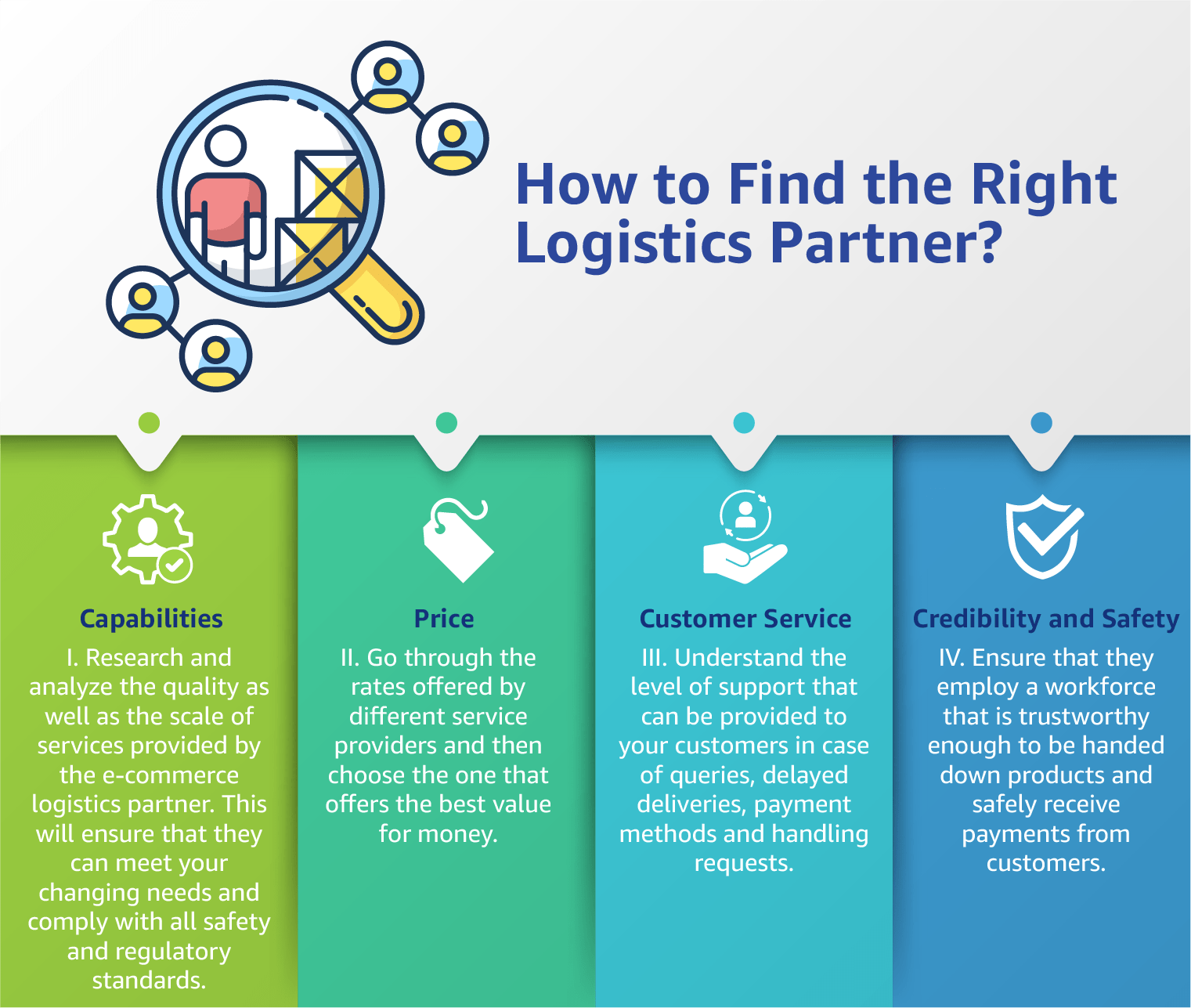
If you wish to partner with an e-commerce logistics company, there are several players in the market that you can choose from. The next question that now arises is – ‘How can you ensure which e-commerce logistics partner is suitable for you? The answer to this question will become quite clear if you look for the following aspects before making your choice:
Capabilities – Research and analyze the quality as well as the scale of services provided by the e-commerce logistics partner. This will ensure that they can meet your changing needs and comply with all safety and regulatory standards.
Price – Go through the rates offered by different service providers and then choose the one that offers better value for money.
Customer Service – Understand the level of support that can be provided to your customers in case of queries, delayed deliveries, payment methods and handling requests.
Credibility and Safety – Ensure that they employ a workforce that is trustworthy enough to be entrusted with the task of managing products and payments from customers.
The ideal way to ensure the most suitable e-commerce logistics provider would be to collaborate with a reliable ecommerce platform that works with the best e-commerce logistics companies.
Capabilities – Research and analyze the quality as well as the scale of services provided by the e-commerce logistics partner. This will ensure that they can meet your changing needs and comply with all safety and regulatory standards.
Price – Go through the rates offered by different service providers and then choose the one that offers better value for money.
Customer Service – Understand the level of support that can be provided to your customers in case of queries, delayed deliveries, payment methods and handling requests.
Credibility and Safety – Ensure that they employ a workforce that is trustworthy enough to be entrusted with the task of managing products and payments from customers.
The ideal way to ensure the most suitable e-commerce logistics provider would be to collaborate with a reliable ecommerce platform that works with the best e-commerce logistics companies.
Disclaimer: This blog is provided on a best-effort basis and suggests ways to enhance your business, and there is no assurance as to its accuracy, completeness or usefulness or that such information is error-free. Amazon hereby disclaims any and all liability and assumes no responsibility whatsoever for consequences resulting from use of such information. You may decide to either accept or reject these suggestions in your sole discretion. Implementation of these suggestions may be subject to applicable laws. Please contact your consultants to understand your obligations and compliance under the applicable laws. You expressly waive any and all claims, rights of action and/or remedies (under law or otherwise) that you may have against Amazon and/or its affiliates arising out of or in connection with the use of or reliance upon such information.
Disclaimer: Whilst Amazon Seller Services Private Limited ("Amazon") has used reasonable endeavours in compiling the information provided, Amazon provides no assurance as to its accuracy, completeness or usefulness or that such information is error-free. In certain cases, the blog is provided by a third-party seller and is made available on an "as-is" basis. Amazon hereby disclaims any and all liability and assumes no responsibility whatsoever for consequences resulting from use of such information. Information provided may be changed or updated at any time, without any prior notice. You agree to use the information, at your own risk and expressly waive any and all claims, rights of action and/or remedies (under law or otherwise) that you may have against Amazon arising out of or in connection with the use of such information. Any copying, redistribution or republication of the information, or any portion thereof, without prior written consent of Amazon is strictly prohibited.
Small Business Resources
Signup for our newsletter and get notified when we publish new articles for free directly into your inbox.
Browse Bizzopedia by Category
Get the latest updates on all things business
Share you information to subscribe and get updates on business guides, trends, tips
Share the knowledge of Bizzopedia


Article Categories
Amazon Programs for SMBs
